| Обновлено 2020-04-14 20:33:21 |
|
Металлорежущий инструмент и инструментальная оснастка / Cutting tools and tooling system ISCAR | Каталог ISCAR 2017 Вращающийся режущий инструмент и оснастка (Всего 1076 стр.) |
|||||
694 Каталог ISCAR 2017 Вращающийся режущий инструмент и инструментальная оснастка Стр.690 |
|||||
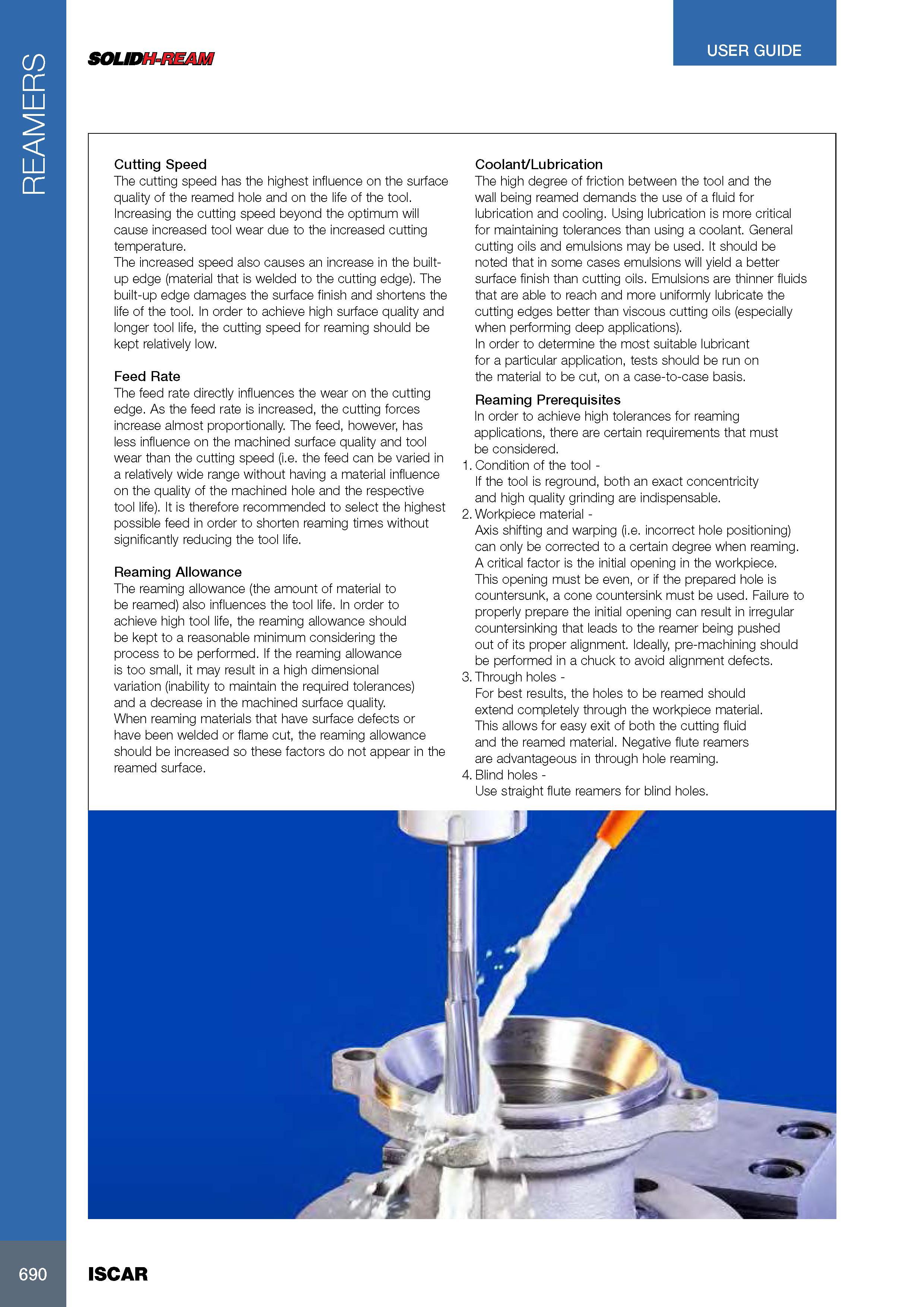
Каталог ISCAR 2017 Ротационный инструмент Стр. 690 0694 ENG Lab2u REAMERS 690 SOLIDH-REAM USER GUIDE Cutting Speed The cutting speed has the highest influence on the surface quality of the reamed hole and on the life of the tool. Increasing the cutting speed beyond the optimum will cause increased tool wear due to the increased cutting temperature. The increased speed also causes an increase in the built-up edge (material that is welded to the cutting edge). The built-up edge damages the surface finish and shortens the life of the tool. In order to achieve high surface quality and longer tool life, the cutting speed for reaming should be kept relatively low. Feed Rate The feed rate directly influences the wear on the cutting edge. As the feed rate is increased, the cutting forces increase almost proportionally. The feed, however, has less influence on the machined surface quality and tool wear than the cutting speed (i.e. the feed can be varied in a relatively wide range without having a material influence on the quality of the machined hole and the respective tool life). It is therefore recommended to select the highest possible feed in order to shorten reaming times without significantly reducing the tool life. Reaming Allowance The reaming allowance (the amount of material to be reamed) also influences the tool life. In order to achieve high tool life, the reaming allowance should be kept to a reasonable minimum considering the process to be performed. If the reaming allowance is too small, it may result in a high dimensional variation (inability to maintain the required tolerances) and a decrease in the machined surface quality. When reaming materials that have surface defects or have been welded or flame cut, the reaming allowance should be increased so these factors do not appear in the reamed surface. Coolant/Lubrication The high degree of friction between the tool and the wall being reamed demands the use of a fluid for lubrication and cooling. Using lubrication is more critical for maintaining tolerances than using a coolant. General cutting oils and emulsions may be used. It should be noted that in some cases emulsions will yield a better surface finish than cutting oils. Emulsions are thinner fluids that are able to reach and more uniformly lubricate the cutting edges better than viscous cutting oils (especially when performing deep applications). In order to determine the most suitable lubricant for a particular application, tests should be run on the material to be cut, on a case-to-case basis. Reaming Prerequisites In order to achieve high tolerances for reaming applications, there are certain requirements that must be considered. 1. Condition of the tool - If the tool is reground, both an exact concentricity and high quality grinding are indispensable. 2. Workpiece material - Axis shifting and warping (i.e. incorrect hole positioning) can only be corrected to a certain degree when reaming. A critical factor is the initial opening in the workpiece. This opening must be even, or if the prepared hole is countersunk, a cone countersink must be used. Failure to properly prepare the initial opening can result in irregular countersinking that leads to the reamer being pushed out of its proper alignment. Ideally, pre-machining should be performed in a chuck to avoid alignment defects. 3. Through holes - For best results, the holes to be reamed should extend completely through the workpiece material. This allows for easy exit of both the cutting fluid and the reamed material. Negative flute reamers are advantageous in through hole reaming. 4. Blind holes - Use straight flute reamers for blind holes. ISCAR |
|||||
См.также / See also : |
|||||
Оснастка для токарных станков по металлу / Lathe tool holders |
Оснастка для сверлильных и фрезерных станков / Tool holders for drilling and milling |
||||
Термопатроны / Shrink fit chuck |
Гидравлический патрон инструментальный / Hydraulic chucks |
||||
Хвостовики инструментов / Shank tool |
Резьбонарезные патроны для метчиков / Tapping chucks |
||||
Балансировка инструмента / Tool balancing |
Штревель / Pull stud |
||||
| |
|||||
| ISCAR | |||||
| |
|||||
 Каталог ISCAR 2017 Вращающийся режущий инструмент и оснастка (англ.яз. / ENG) (1076 страниц) |
 Каталог ISCAR 2017 Токарный металлорежущий инструмент и оснастка (англ.яз. / ENG) (628 страниц) |
 Каталог ISCAR 2016 Новый режущий инструмент и оснастка (англ.яз. / ENG) (304 страницы) |
 Каталог ISCAR 2015 Новая продукция для металлообработки (324 страницы) |
 Каталог ISCAR 2012 Токарный канавочный инструмент (418 страниц) |
 Каталог ISCAR 2012 Точение и нарезание резьбы (470 страниц) |
 Каталог ISCAR 2012 Фрезерный инструмент со сменными пластинами (583 страницы) |
 Каталог ISCAR 2012 Фрезерный монолитный инструмент (184 страницы) |
 Каталог ISCAR 2012 Режущий инструмент для обработки отверстий (448 страниц) |
 Каталог ISCAR 2012 Инструментальная оснастка (342 страницы) |
 Каталог ISCAR 2010 Новый инструмент для металлообработки (272 страницы) |
 Каталог ISCAR 2008 Токарный инструмент (680 страниц) |
 Каталог ISCAR 2008 Вращающийся инструмент (1049 страниц) |
 Каталог ISCAR 2005 Металлорежущий инструмент и оснастка (1166 страниц) |
 Руководство ISCAR 2011 Инструмент для производства штампов (168 страниц) |
|||
| |
|||||
|
Каталоги инструмента и оснастки для металлообработки на станках / Cutting tools and tooling system catalogs |
|||||
| Каталог ISCAR 2017 Вращающийся режущий инструмент и оснастка (Всего 1076 стр.) | |||||
| |
|||||
 691 691 |  692 692 |  693 693 |  695 695 |  696 696 |  697 697 |
|
Lab2U | Catalogs | Tap drill sizes | Speed to RPM | Material table Разработчики сайта / Developers of site |
|
Поиск на сайте Lab2u.ru с помощью поисковых систем ЯНДЕКС, BING, GOOGLE:
|
||
|
|
||
