| Обновлено 2020-04-12 18:38:23 |
|
Металлорежущий инструмент и инструментальная оснастка для станков INGERSOLL | Каталог INGERSOLL 2011 Инструмент и оснастка (Всего 1440 стр.) |
|||||
306 Каталог INGERSOLL 2011 Режущий инструмент и инструментальная оснастка Стр.308 |
|||||
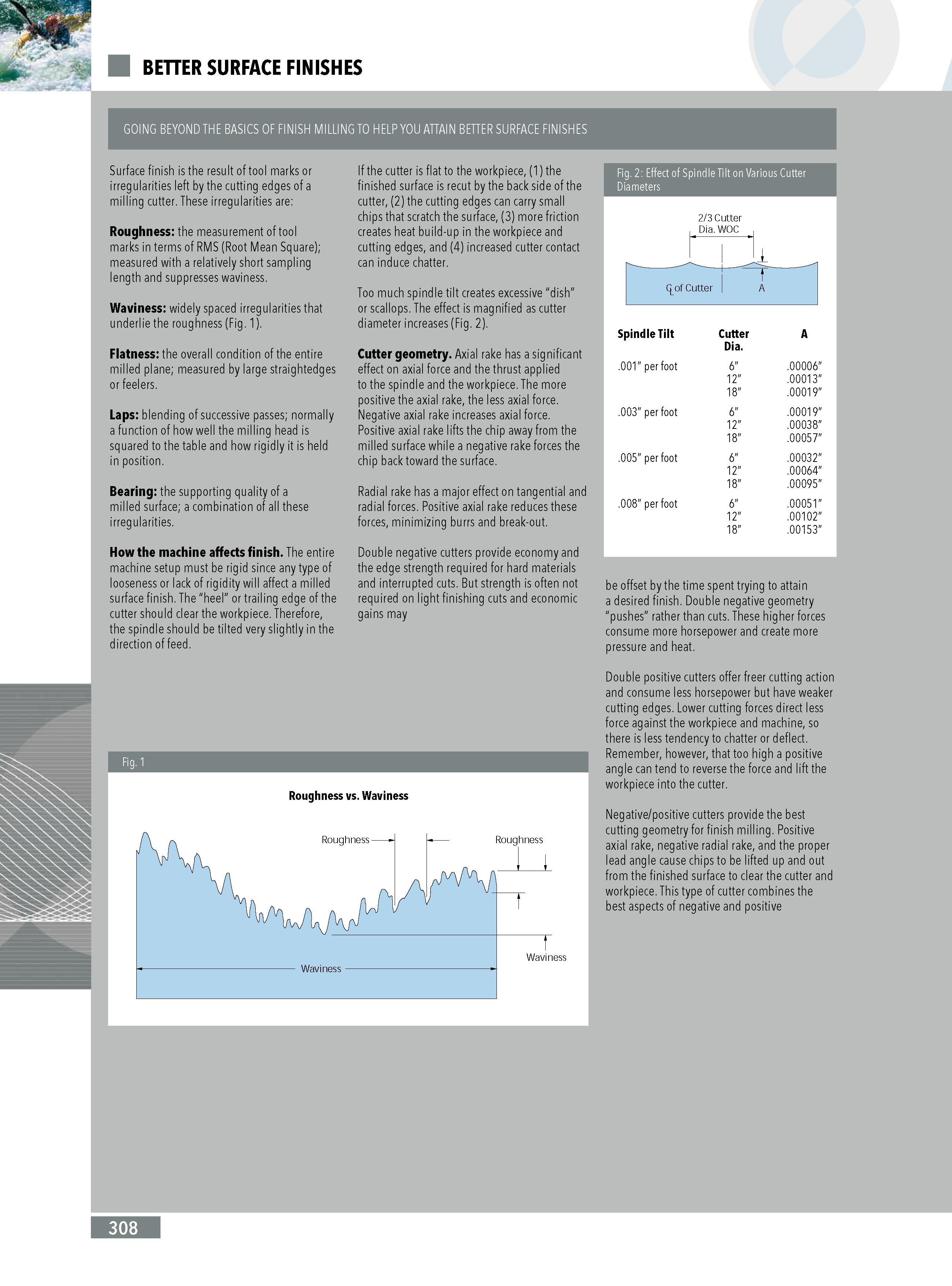
Каталог INGERSOLL 2011 Инструмент и оснастка Стр. 308 0306 Lab2u BETTER SURFACE FINISHES GOING BEYOND THE BASICS OF FINISH MILLING TO HELP YOU ATTAIN BETTER SURFACE FINISHES Surface finish is the result of tool marks or irregularities left by the cutting edges of a milling cutter. These irregularities are: Roughness: the measurement of tool marks in terms of RMS (Root Mean Square); measured with a relatively short sampling length and suppresses waviness. Waviness: widely spaced irregularities that underlie the roughness (Fig. 1). Flatness: the overall condition of the entire milled plane; measured by large straightedges or feelers. Laps: blending of successive passes; normally a function of how well the milling head is squared to the table and how rigidly it is held in position. Bearing: the supporting quality of a milled surface; a combination of all these irregularities. How the machine affects finish. The entire machine setup must be rigid since any type of looseness or lack of rigidity will affect a milled surface finish. The "heel or trailing edge of the cutter should clear the workpiece. Therefore the spindle should be tilted very slightly in the direction of feed. If the cutter is flat to the workpiece (1) the finished surface is recut by the back side of the cutter (2) the cutting edges can carry small chips that scratch the surface (3) more friction creates heat build-up in the workpiece and cutting edges and (4) increased cutter contact can induce chatter. Too much spindle tilt creates excessive "dish or scallops. The effect is magnified as cutter diameter increases (Fig. 2). Cutter geometry. Axial rake has a significant effect on axial force and the thrust applied to the spindle and the workpiece. The more positive the axial rake the less axial force. Negative axial rake increases axial force. Positive axial rake lifts the chip away from the milled surface while a negative rake forces the chip back toward the surface. Radial rake has a major effect on tangential and radial forces. Positive axial rake reduces these forces minimizing burrs and break-out. Double negative cutters provide economy and the edge strength required for hard materials and interrupted cuts. But strength is often not required on light finishing cuts and economic gains may Fig. 2: Effect of Spindle Tilt on Various Cutter Diameters 2 3 Cutter Dia. WOC Spindle Tilt Cutter Dia. A .001 per foot 6 .00006 12 .00013 18 .00019 .003 per foot 6 .00019 12 .00038 18 .00057 .005 per foot 6 .00032 12 .00064 18 .00095 .008 per foot 6 .00051 12 .00102 18 .00153 be offset by the time spent trying to attain a desired finish. Double negative geometry "pushes rather than cuts. These higher forces consume more horsepower and create more pressure and heat. Double positive cutters offer freer cutting action and consume less horsepower but have weaker cutting edges. Lower cutting forces direct less force against the workpiece and machine so there is less tendency to chatter or deflect. Remember however that too high a positive angle can tend to reverse the force and lift the workpiece into the cutter. Negative positive cutters provide the best cutting geometry for finish milling. Positive axial rake negative radial rake and the proper lead angle cause chips to be lifted up and out from the finished surface to clear the cutter and workpiece. This type of cutter combines the best aspects of negative and positive 308 |
|||||
См.также / See also : |
|||||
Соотношение твердостей Таблица / Hardness equivalent table |
Аналоги марок стали / Workpiece material conversion table |
||||
Отклонение размера детали / Fit tolerance table |
Перевод оборотов в скорость / Surface speed to RPM conversion |
||||
Диаметр под резьбу / Tap drill sizes |
Виды резьбы в машиностроении / Thread types and applications |
||||
Дюймы в мм Таблица / Inches to mm Conversion table |
Современные инструментальные материалы / Cutting tool materials |
||||
| |
|||||
| INGERSOLL | |||||
| |
|||||
 Каталог INGERSOLL 2016 Инструмент фрезерный и сверлильный (нем.яз. / DEU) (616 страниц) |
 Каталог INGERSOLL 2015 Токарный инструмент (ENG FRA) (560 страниц) |
||||
 Каталог INGERSOLL 2014 Фрезерный инструмент (668 страниц) |
|||||
 Каталог INGERSOLL 2011 Инструмент и оснастка (англ. яз. / ENG) (1440 страниц) |
|||||
| |
|||||
|
Каталоги инструмента и оснастки для металлообработки на станках / Cutting tools and tooling system catalogs |
|||||
| Каталог INGERSOLL 2011 Инструмент и оснастка (Всего 1440 стр.) | |||||
| |
|||||
 303 303 |  304 304 |  305 305 |  307 307 |  308 308 |  309 309 |
|
Lab2U | Catalogs | Tap drill sizes | Speed to RPM | Material table Разработчики сайта / Developers of site |
|
Поиск на сайте Lab2u.ru с помощью поисковых систем ЯНДЕКС, BING, GOOGLE:
|
||
|
|
||
