| Обновлено 2020-04-12 18:38:23 |
|
Металлорежущий инструмент и инструментальная оснастка для станков INGERSOLL | Каталог INGERSOLL 2011 Инструмент и оснастка (Всего 1440 стр.) |
|||||
304 Каталог INGERSOLL 2011 Режущий инструмент и инструментальная оснастка Стр.306 |
|||||
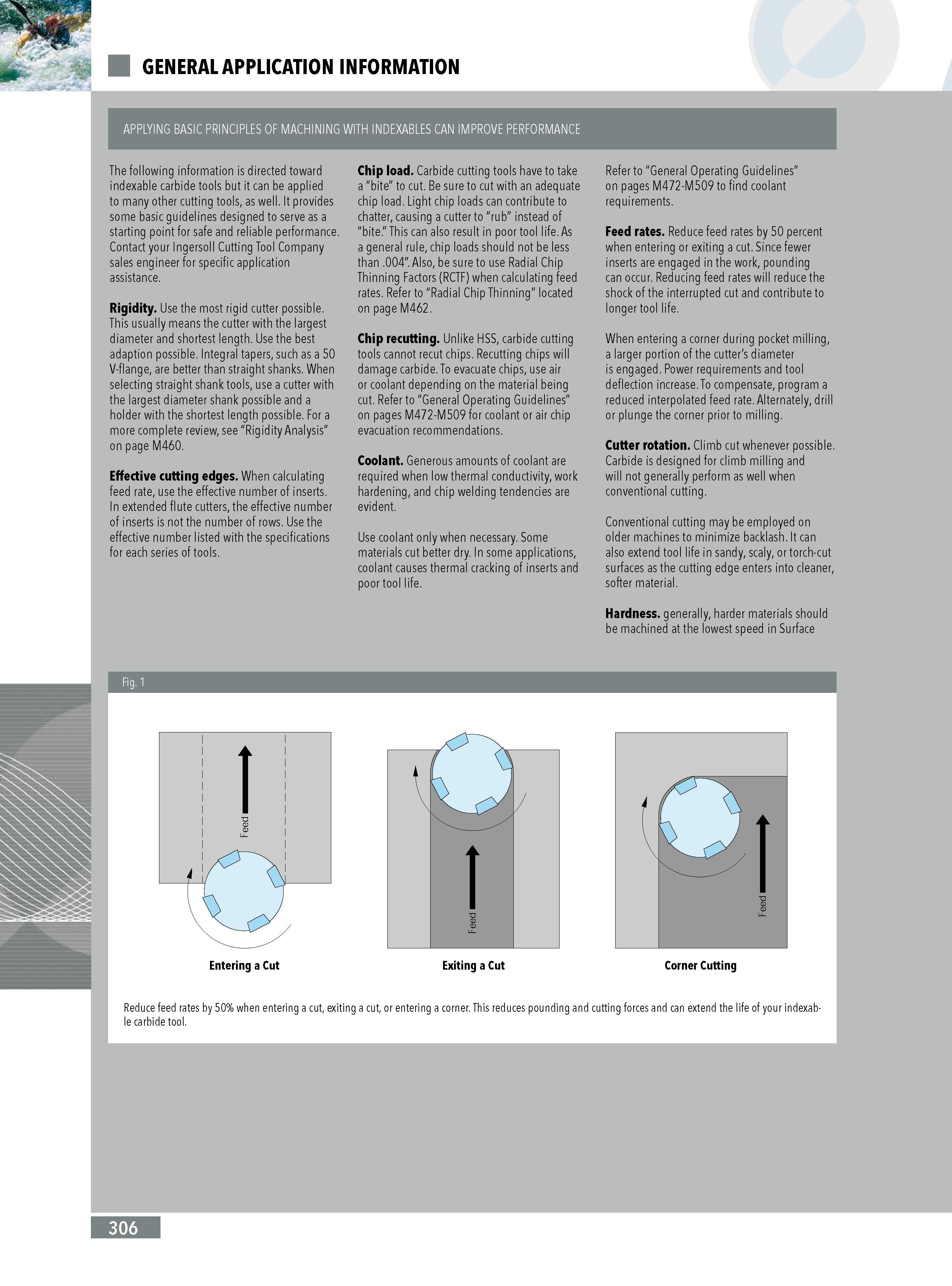
Каталог INGERSOLL 2011 Инструмент и оснастка Стр. 306 0304 Lab2u GENERAL APPLICATION INFORMATION APPLYING BASIC PRINCIPLES OF MACHINING WITH INDEXABLES CAN IMPROVE PERFORMANCE The following information is directed toward indexable carbide tools but it can be applied to many other cutting tools as well. It provides some basic guidelines designed to serve as a starting point for safe and reliable performance. Contact your Ingersoll Cutting Tool Company sales engineer for specific application assistance. Rigidity. Use the most rigid cutter possible. This usually means the cutter with the largest diameter and shortest length. Use the best adaption possible. Integral tapers such as a 50 V-flange are better than straight shanks. When selecting straight shank tools use a cutter with the largest diameter shank possible and a holder with the shortest length possible. For a more complete review see "Rigidity Analysis on page M460. Effective cutting edges. When calculating feed rate use the effective number of inserts. In extended flute cutters the effective number of inserts is not the number of rows. Use the effective number listed with the specifications for each series of tools. Chip load. Carbide cutting tools have to take a "bite to cut. Be sure to cut with an adequate chip load. Light chip loads can contribute to chatter causing a cutter to "rub instead of "bite. This can also result in poor tool life. As a general rule chip loads should not be less than .004. Also be sure to use Radial Chip Thinning Factors (RCTF) when calculating feed rates. Refer to "Radial Chip Thinning located on page M462. Chip recutting. Unlike HSS carbide cutting tools cannot recut chips. Recutting chips will damage carbide. To evacuate chips use air or coolant depending on the material being cut. Refer to "General Operating Guidelines on pages M472-M509 for coolant or air chip evacuation recommendations. Coolant. Generous amounts of coolant are required when low thermal conductivity work hardening and chip welding tendencies are evident. Use coolant only when necessary. Some materials cut better dry. In some applications coolant causes thermal cracking of inserts and poor tool life. Refer to "General Operating Guidelines on pages M472-M509 to find coolant requirements. Feed rates. Reduce feed rates by 50 percent when entering or exiting a cut. Since fewer inserts are engaged in the work pounding can occur. Reducing feed rates will reduce the shock of the interrupted cut and contribute to longer tool life. When entering a corner during pocket milling a larger portion of the cutter's diameter is engaged. Power requirements and tool deflection increase. To compensate program a reduced interpolated feed rate. Alternately drill or plunge the corner prior to milling. Cutter rotation. Climb cut whenever possible. Carbide is designed for climb milling and will not generally perform as well when conventional cutting. Conventional cutting may be employed on older machines to minimize backlash. It can also extend tool life in sandy scaly or torch-cut surfaces as the cutting edge enters into cleaner softer material. Hardness. generally harder materials should be machined at the lowest speed in Surface Entering a Cut Reduce feed rates by 50% when entering a cut exiting a cut or entering a corner. This reduces pounding and cutting forces and can extend the life of your indexable carbide tool. Fig. 1 306 |
|||||
См.также / See also : |
|||||
Соотношение твердостей Таблица / Hardness equivalent table |
Аналоги марок стали / Workpiece material conversion table |
||||
Отклонение размера детали / Fit tolerance table |
Перевод оборотов в скорость / Surface speed to RPM conversion |
||||
Диаметр под резьбу / Tap drill sizes |
Виды резьбы в машиностроении / Thread types and applications |
||||
Дюймы в мм Таблица / Inches to mm Conversion table |
Современные инструментальные материалы / Cutting tool materials |
||||
| |
|||||
| INGERSOLL | |||||
| |
|||||
 Каталог INGERSOLL 2016 Инструмент фрезерный и сверлильный (нем.яз. / DEU) (616 страниц) |
 Каталог INGERSOLL 2015 Токарный инструмент (ENG FRA) (560 страниц) |
||||
 Каталог INGERSOLL 2014 Фрезерный инструмент (668 страниц) |
|||||
 Каталог INGERSOLL 2011 Инструмент и оснастка (англ. яз. / ENG) (1440 страниц) |
|||||
| |
|||||
|
Каталоги инструмента и оснастки для металлообработки на станках / Cutting tools and tooling system catalogs |
|||||
| Каталог INGERSOLL 2011 Инструмент и оснастка (Всего 1440 стр.) | |||||
| |
|||||
 301 301 |  302 302 |  303 303 |  305 305 |  306 306 |  307 307 |
|
Lab2U | Catalogs | Tap drill sizes | Speed to RPM | Material table Разработчики сайта / Developers of site |
|
Поиск на сайте Lab2u.ru с помощью поисковых систем ЯНДЕКС, BING, GOOGLE:
|
||
|
|
||
